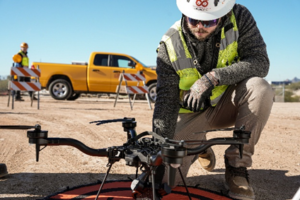
Learn more about the technology implemented on Hensel Phelps projects.
View More

For almost 90 years, Hensel Phelps has built across the United States, delivering aviation, infrastructure, healthcare, commercial projects and more, despite the weather. For construction teams working outdoors, extreme heat can be part of their daily jobsite environment. Those conditions require careful planning as project teams work to send every employee and trade partner home safely.

In April 2026, the Occupational Safety and Health Administration (OSHA) renewed its National Emphasis Program for outdoor and indoor heat-related hazards, including construction. The agency notes that physical work in high temperatures, along with heavy or bulky clothing and equipment can lead to increased heat-related risk. That work is especially relevant in Arizona, where Diverge, a Hensel Phelps company, is exploring whether emerging wearable technology could be another tool for teams.

Exploring Eztia’s HydraVolt™ Technology

Diverge is collaborating with Eztia, a San-Francisco-based tech startup developing cooling materials for those working in hot environments. The technology responds as body temperature rises by drawing heat away from the skin and dispersing it through the fabric.

Eztia's HydraVolt™ material. Detail shot

Eztia’s HydraVolt™ technology incorporates a proprietary cooling gel directly into performance fabric. The company reports that HydraVolt™ can reduce skin surface temperature by up to 10 degrees Celsius and provide up to eight hours of cooling during strenuous physical activity. Additionally, the technology does not require batteries or electricity and can be reactivated with water.

Wearable cooling technology does not replace established heat-illness prevention practices, but it could serve as an additional layer of support for employees. Evaluating solutions like HydraVolt™ can also help teams better understand where emerging technologies may have a practical role in jobsite safety.

Evaluating Performance Beyond the First Test

Diverge’s role is to understand how solutions like this perform outside the lab and in conditions that more closely reflect the realities of construction work. Kyle Tomak, Diverge senior innovation manager, first tested the HydraVolt™ material while landscaping outdoors over a 114-degree weekend in Phoenix, Arizona. Impressed by how long the fabric remained cool, Tomak then distributed the solution to Hensel Phelps safety directors nation-wide for project team testing and feedback.

This round of evaluation focuses on how the solution performs under the demands and conditions of day-to-day field work. Early feedback has been encouraging, while also highlighting practical considerations for extended use. After several hours, the material needed to be reactivated with water, an important factor when evaluating how wearable cooling technology could fit into a full construction workday.

For wearable cooling technology, that means considering questions such as:

  • How long does the cooling effect last under different working conditions?
  • How easily can the material be reactivated during the workday?
  • Is it comfortable enough for extended use?
  • How does it hold up under repeated wear?
  • Is it compatible with existing personal protective equipment?
  • Does its performance remain consistent across different environments and types of work?

Materials integrated into everyday workwear may eventually offer another way to help construction workers manage environmental conditions in the field. The Diverge team will continue collaborating with Eztia to test it’s HydraVolt™ material across real-world conditions and better understand its durability, usability and potential applications.

What Wearable Cooling Could Mean for Construction Safety

Hensel Phelps teams working in regions where triple-digit temperatures are a regular part of the construction environment, continuing to explore those questions matters. Through Diverge, Hensel Phelps can evaluate new approaches with the people who may ultimately use them, keeping innovation connected to practical application and focused on helping teams work safer, efficiently and more effectively.

View the Full Article
See More

Addressing Challenges

Led by the Rocky Mountain Region Virtual Design and Construction (VDC) team with support from Diverge, a Hensel Phelps company, the initiative pilots Unreal Engine, a real-time 3D development platform, to create interactive environments that help project teams better understand existing conditions before construction begins.

Key Takeaways

Addressing Aging Infrastructure: Municipal water and wastewater systems present significant challenges due to deteriorating underground infrastructure, incomplete utility records and the need to maintain uninterrupted operations during rehabilitation.

Immersive Project Visualization: By combining Building Information Modeling (BIM), LiDAR reality capture scans and Unreal Engine, project teams can explore facilities in a fully interactive environment, improving communication, constructability reviews and decision-making before work reaches the field.

Improved Coordination: The technology helps owners, designers and builders identify potential conflicts early, evaluate construction sequencing and better understand how new systems will integrate with existing infrastructure.

Real-World Application: At the Windsor Wastewater Treatment Facility, Hensel Phelps overlaid LiDAR scans with BIM models to gain a more accurate understanding of constrained underground conditions, strengthening coordination and reducing uncertainty before construction.

Supporting Existing VDC Workflows: Rather than replacing current VDC tools, Unreal Engine enhances established capabilities such as constructability reviews, 4D planning, digital coordination and owner engagement through more immersive visualization experiences.

Why It Matters

The pilot demonstrates how gaming technology can be adapted for construction planning, allowing project teams to make more informed decisions, reduce project risk and improve collaboration on highly constrained water infrastructure projects. As investment in resilient water and wastewater systems continues to grow, Hensel Phelps is evaluating immersive visualization as another tool to support safer, more coordinated and efficient project delivery.

Thai Nguyen, director of innovation at Hensel Phelps, joined Heavy Hitters: The Digital Industrial Podcast to discuss how Diverge is supporting early-stage innovators and scaling transformative ideas across the AEC industry. The episode explored Diverge’s role in driving progress in the built environment through human-centered impact, robotics and automation.

The podcast, which brings together leaders from heavy industrial sectors and the venture capital ecosystem, featured Nguyen’s insights on partnering with startups and fostering digital innovation. Listeners heard how Diverge helps bridge the gap between emerging technologies and real-world construction applications by promoting scalable solutions that advance productivity and collaboration.

Click here to listen to the Heavy Hitters podcast. 

Logo of Heavy Hitters Podcast

Hensel Phelps is accelerating the use of robotics in construction through a structured, deliberate approach led by its innovative arm, Diverge. The company collaborates with technology leaders such as Hewlett-Packard (HP) and Hilti, Inc. to evaluate and pilot new automation tools. These trials include deploying HP SitePrint, a layout robot, which demonstrably halved layout time while achieving 100 percent accuracy on one Arizona project. Diverge also evaluated Hilti’s Jaibot for autonomous drilling tasks. In each case, the program managed controlled testing protocols, gathered onsite feedback and facilitated seamless integration into operations

Looking ahead, Diverge plans to extend this methodology across multiple projects and robotics applications. Mihir Somalwar, an Innovation Lead at Diverge, notes that growth in artificial intelligence (AI) technologies marks 2024 as a milestone year for robotics in construction. By combining systematic pilots with strategic collaboration and data‑driven insights, Hensel Phelps is pioneering a safer, more efficient and sustainable future for the construction industry.

Visit CIORiview to read the full article.


Thai Nguyen, director of innovation at Hensel Phelps and leader of its Diverge initiative, shared his career journey and insights on scaling construction technology from the ground up. Starting in the field and growing into one of the company’s earliest BIM champions, Nguyen helped shape the firm’s VDC program during a pivotal period in 2012. A milestone project with a major microchip manufacturer helped accelerate Hensel Phelps’ digital transformation, giving rise to enterprise-wide adoption of model-based coordination, schedule integration and material quantification. Nguyen emphasized that strong field experience and leadership trust were critical to driving meaningful change and breaking traditional business-as-usual cycles.

Today, Diverge functions as a strategic innovation and investment platform focused on curating scalable solutions that integrate seamlessly with Hensel Phelps’ operations. In response to growing tech stack complexity and fragmented systems, Diverge formalizes how the company identifies, tests and scales new tools. Nguyen underscored the importance of cross-industry collaboration, transparent feedback loops and shared ownership of innovation with trade partners, owners and other general contractors. With a structured startup intake process and new investment capabilities, Diverge is building a foundation to drive long-term impact across the construction ecosystem, supporting both internal transformation and industry-wide progress.

Learn more by visiting Medium. 


Despite advancements in digital tools, the construction industry continues to face challenges with fragmented data, siloed systems and the growing complexity of integrating new technologies. Hensel Phelps established Diverge, its innovation and investment arm, to address these barriers and lead the industry’s digital transformation. Diverge focuses on breaking down silos, advancing data interoperability and connecting construction professionals with scalable, integrated solutions. With a broad network that includes startups, academic institutions and technology vendors, Diverge is developing a pipeline to organize project data across safety, quality, field operations and construction technology to support better decision-making and long-term growth.

As a longtime leader in project delivery innovation, Hensel Phelps recognizes the importance of adopting the right tools at the right time. Leaders across the organization emphasize how collaborative project delivery strategies, such as design-build, foster data sharing and increase project value. Diverge is currently testing technologies that include field robotics, AR/VR systems, safety wearables and AI-powered predictive tools that enhance site safety and operational efficiency. The company’s innovation center will serve as a hub for testing and validating emerging technologies. By combining technology with a strong culture of inclusion, training and collaboration, Diverge ensures that innovation is driven by people and focused on the future of construction.

Learn more by visiting DBIA. 


Hensel Phelps has partnered with Track3D to enhance progress tracking and operational efficiency across complex construction projects. The AI-powered platform uses 360-degree imagery, lidar, drones and other data sources to automate the documentation and monitoring of installed elements like drywall, ductwork and piping. This integration eliminates time-consuming manual inspections, providing field teams with accurate trade-specific reports and trend analyses. The data enables proactive scheduling, improves resource allocation and supports milestone-based payments. By standardizing on Track3D, Hensel Phelps reduces tech stack complexity, eliminates data silos and drives greater consistency across its enterprise operations.

The company is also exploring opportunities to connect Track3D insights with additional technologies, including IoT sensors and robotics. These integrations offer real-time visibility into workforce movement, site layout efficiency and safety protocol adherence. Track3D’s deviation detection features compare lidar scans with BIM models, allowing teams to identify and correct discrepancies before they become costly issues. Leaders at Hensel Phelps, including Thai Nguyen and Mihir Somalwar, emphasize that this strategic investment reflects the company’s commitment to innovation, safety and continuous improvement. By automating routine tasks and embracing intelligent systems, Hensel Phelps is setting new standards in digital construction practices.

Learn more by visiting Construction Executive.


On Tuesday, September 12, Thai Nguyen alongside Shadow Ventures’ Founder & CEO, KP Reddy and View, Inc.’s CEO Rao Mulpuri spoke at Blueprint – The Future of the Built World conference during a breakout session titled “Why Software Won’t Save Real Estate.” The session discussed how Diverge and other construction tech startups challenge the way they approach innovating and investing in software as an end solution.

Blueprint is the largest, most global fathering of industry leaders and innovators leading the charge in changing the built world. From construction to transaction, the conference focuses on learning, networking and innovative advancements in the industry.

Diverge’s Thai Nguyen joins Trimble’s Connected Construction podcast to discuss how Hensel Phelps ensures they extract insightful data and meaningful action from the typical 30-35 point solutions per project. Like many contractors, Hensel Phelps struggles with the proliferation of construction point solutions that make up the modern tech stack. Join host Matt Sprague and Hensel Phelps’ Director of Innovation, Thai Nguyen, as they cover this sticky subject while talking about: Using an autonomous robot for night work Connecting point solutions with pay apps FedRAMP-approved general contractor management solutions Leading a corporate venture capital (CVC) within an established organization.

Listen to the full podcast here.

BuiltWorlds has named Hensel Phelps’ Director of Innovation Thai Nguyen among their 2023 Maverick’s 50 List. Comprised of those from architects and entrepreneurs to industry leaders, technologists to investors, and those developing both off-site fabrication and on-site robotics, BuiltWorlds has identified boundary-pushers from leading companies around the world, and across the built environment’s vast ecosystem.

“Thai Nguyen is an instrumental force within the built world, with over 20 years of experience within the industry. At Hensel Phelps, Nguyen is leading the newly launched innovation arm of Hensel Phelps, Diverge, which will be working directly with startups to foster innovation within the industry.”

Check out the full list of Mavericks here.